UCF Knights vs Arizona Wildcats Picks, Prediction, Odds, and Line Movement for Thursday March 12 2026
The Big 12 Tournament in Kansas City has no shortage of lopsided quarterfinal projections, but the Arizona-UCF matchup on Thursday afternoon is the one game on the bracket where the most important handicapping question is not who wins — it is how much the Wildcats win by, and whether a Knights team running on overtime fumes can keep this competitive long enough for the total to matter. Arizona enters at 29-2 as one of the nation's most complete teams and the Wildcats already won the regular-season meeting in Orlando, while UCF just survived a Thursday overtime game against Cincinnati less than 24 hours earlier. If you are building Thursday's Big 12 card and want the sharpest college basketball picks to anchor your slate, this Arizona-UCF quarterfinal has the spread, the fatigue angle and the total all pointing toward the same conclusion — and the market has already started moving one of those numbers significantly overnight.
Quick Picks and Prediction
- Spread Pick: Arizona -15.5
- Total Pick: Under 159.5
- Projected Final Score: Arizona 86, UCF 68
Odds and Line Movement
Opening Odds
| Team | Spread | Total |
|---|---|---|
| Central Florida | +16.5 (-104) | Over 159.5 (-115) |
| Arizona | -16.5 (-118) | Under 159.5 (-105) |
Current Odds
| Team | Spread | Total |
|---|---|---|
| Central Florida | +15.5 (-105) | Over 159.5 (-115) |
| Arizona | -15.5 (-115) | Under 159.5 (-105) |
Line Movement - Spread
| Date | Time | Central Florida | Arizona | Public ($, #) |
|---|---|---|---|---|
| 03/11 | 06:31:10 PM | +16.5 (-104) | -16.5 (-118) | |
| 03/11 | 08:07:17 PM | +16.5 (-108) | -16.5 (-112) | |
| 03/12 | 12:05:54 AM | +16.5 (-118) | -16.5 (-104) | ARIZ 100%, ARIZ 100% |
| 03/12 | 05:08:09 AM | +15.5 (-105) | -15.5 (-115) | ARIZ 92%, ARIZ 75% |
Line Movement - Total
| Date | Time | Over | Under | Public ($, #) |
|---|---|---|---|---|
| 03/11 | 06:31:10 PM | 159.5 (-115) | 159.5 (-105) |
UCF vs Arizona Key Matchups and Handicap
The spread movement overnight is the first thing sharp bettors should be examining before any other analytical factor in this game. Arizona opened at -16.5 and the line has ticked down a full point to -15.5, driven by 100% Arizona money at the midnight window and then 92% Arizona positioning at the morning posting. Books adjusted the number — not the juice toward UCF to balance the book, but the actual spread number dropping in the Wildcats' favor — which means the volume of Arizona action was significant enough to force a price concession. In practical terms, this tells bettors that sharp money has been arriving on Arizona at a sufficient volume to move the number, and the current -15.5 is where the market has landed after absorbing all of that directional pressure.

The January 17 meeting in Orlando is the most directly applicable data in this entire handicap, and it produced a blueprint that every Arizona backer should find reassuring. UCF got 30 points from Themus Fulks — a career-level individual performance from the Knights' primary playmaker — and still lost 84-77 as Arizona placed five players in double figures and controlled the interior possessions that determined the final margin. The Wildcats won that game without requiring a heroic individual output from any single player, which is the signature of a team with genuine structural depth rather than one that depends on a single star performing at peak efficiency.
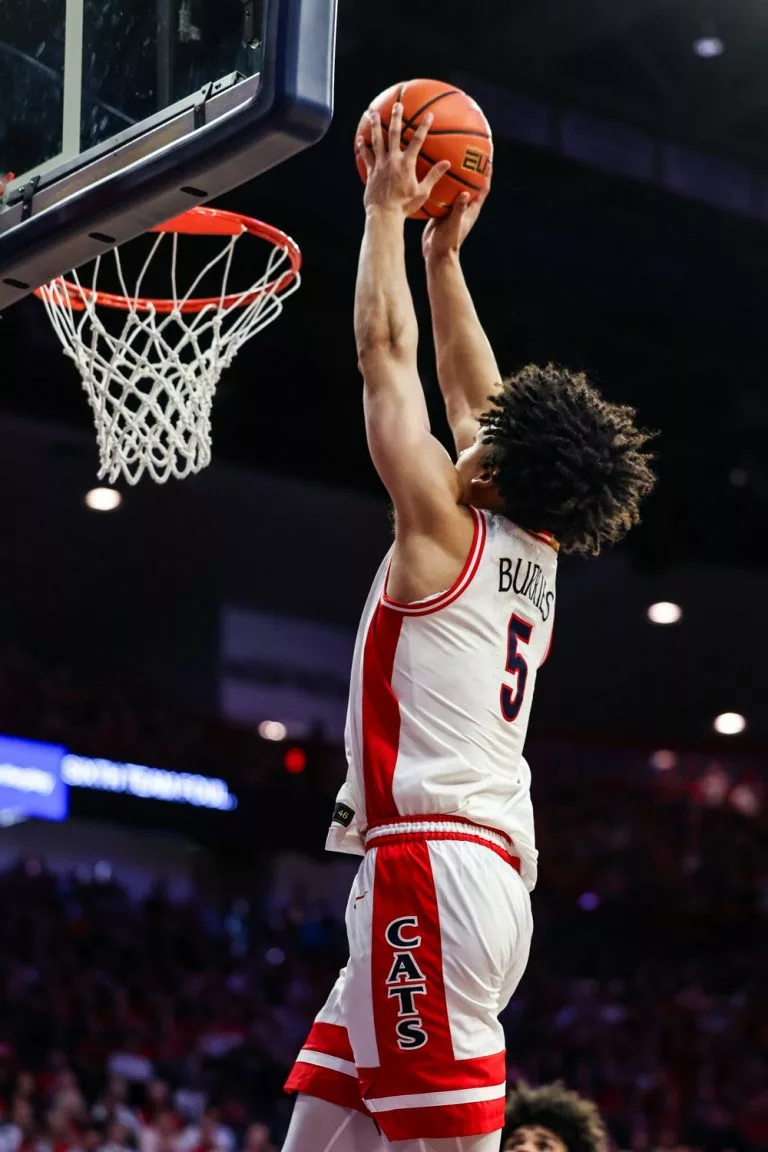
Arizona's personnel construction is what makes the 29-2 record feel earned rather than schedule-inflated. Brayden Burries leads the team at 16.0 points per game, Koa Peat adds 13.8 points and 5.3 rebounds, Jaden Bradley supplies 13.4 points and 4.6 assists from the point guard position, and Motiejus Krivas provides 10.8 points, 8.2 rebounds and 1.8 blocks as a legitimate interior anchor. Tobe Awaka anchors the glass at 9.5 rebounds per game, completing a frontcourt depth combination that has made Arizona one of the nation's most difficult teams to outscore when the game tightens and physical possession-by-possession basketball determines the outcome. The Wildcats average 86.7 points per game while allowing just 68.6 — an 18-point efficiency margin that represents one of the nation's most dominant net ratings and directly explains why 15 points is not an unreasonable spread against a 21-10 UCF team playing its second game in less than 24 hours.
Get Free $30 Credit for Premium Picks + Exclusive Discounts
Subscribe Now
UCF's case for staying within the number is built on offensive explosiveness and individual shot-making talent rather than structural advantages. Riley Kugel leads the Knights at 14.7 points per game, Fulks averages 14.1 points and 6.8 assists, Jordan Burks adds 13.1 points, and Jamichael Stillwell provides the interior presence at 11.8 points and 7.9 rebounds per night. Stillwell's 17-point, 15-rebound effort in Wednesday's overtime win over Cincinnati was an exceptional individual performance, but the same game that produced those numbers also generated the back-to-back fatigue situation that fundamentally changes UCF's energy profile for Thursday afternoon. An overtime game is not a standard 40-minute tournament result — it is a 45-minute physical and mental expenditure that compounds on already-accumulated tournament travel stress.
The fatigue variable is the most underappreciated element in this entire handicap. UCF's overtime game against Cincinnati did not just cost the Knights five extra minutes of game time — it cost them deeper rotation minutes from every player who was on the floor in the extended period, and it means Thursday's preparation was compressed by the late finish and the reality that meaningful sleep and recovery time was unavailable between games. Arizona, coming in fresh and fully rested, will be playing against a UCF team whose legs could betray them in the exact second-half stretches where the Wildcats' depth advantage typically creates the separation that covers large spreads.
The total holding flat at 159.5 throughout tracking reflects the genuine uncertainty about whether UCF's fatigue suppresses the Knights' offensive efficiency enough to push the game below a number built on both teams' full-strength offensive profiles. Arizona averages 86.7 per game and UCF can score in bunches — on paper, 159.5 is not an absurd total for two teams with these offensive reputations. But UCF's overtime game changes the calculus materially, and Arizona's 68.6 points allowed per game means the Wildcats have the defensive structure to limit UCF's output when the Knights are not operating at full capacity. The under becomes the play when the total is priced for two fresh offenses and one of the teams is running on empty.
UCF and Arizona Betting Trends
Arizona's spread movement from -16.5 to -15.5 on back-to-back windows of 100% and 92% Arizona public money is the most important trend signal on this game's board. A full-point move in the favorite's direction on near-unanimous public positioning means books conceded the number rather than fighting the directional pressure, and that concession reflects the volume and conviction of Arizona money arriving in the overnight hours after UCF's overtime game concluded. The 29-2 record and the first-meeting blueprint both confirm the Wildcats as the right side at any reasonable spread below 20.
UCF's trend profile entering Thursday is defined by two competing forces: the offensive firepower that gave Arizona trouble in January and the back-to-back overtime fatigue that creates a measurable performance disadvantage. The Knights' four double-digit scorers give them enough individual talent to generate scoring in bunches regardless of physical state, but sustaining that offensive output for 40 minutes against Arizona's defensive depth while legs are heavy from an overtime game the previous night is a substantial ask that history suggests teams rarely meet at peak efficiency.
The total holding at 159.5 with the under carrying modest juice reflects the market's acknowledgment that UCF's overtime game has already been priced into the number to some degree — books did not drop the total dramatically because Arizona's offensive ceiling keeps the over viable. The under play is not about the total being obviously wrong; it is about UCF's second-half efficiency declining at exactly the point when Arizona's depth advantage typically manifests in significant scoring separation.
UCF and Arizona Key Injuries and Notes
Koa Peat's lower-leg issue has been the primary injury storyline on Arizona's side over the past several weeks, but the trajectory of that situation heading into Thursday is meaningfully positive. Peat returned for the Wildcats' stretch run and delivered a 25-point performance in the regular-season finale at Colorado — that kind of scoring output from a player returning from a lower-leg concern typically indicates genuine comfort and explosiveness rather than a player managing through pain while limiting his athleticism. The bigger question entering Thursday is whether Peat can sustain that level of performance across tournament games on consecutive days if Arizona advances, but for this specific quarterfinal matchup, his availability at something close to full capacity represents a significant upgrade over the personnel picture when he was absent or limited.
Arizona's rotation instability surrounding Dwayne Aristode has been another variable worth tracking, but the Wildcats' overall roster health entering Kansas City appears substantially better than it was during the stretch when both Peat and Aristode were creating lineup uncertainty. A near-full-strength Arizona team is the version that the 15.5-point spread was posted to reflect, and the line movement toward Arizona overnight confirms the market is pricing in that improved health picture rather than discounting it.
UCF enters without a confirmed rotation loss for Thursday, which makes the overtime fatigue the dominant personnel-adjacent variable for the Knights rather than an injury. Stillwell's 45 minutes of physical interior play against Cincinnati — including the overtime period where his rebounding was particularly critical — means the player Arizona must most specifically prepare for in the paint arrives in Kansas City with the deepest accumulated fatigue of anyone in this matchup. His ability to match Krivas and Awaka on the glass for a second consecutive game is the single most important physical question in this entire handicap.
ATS and Total Picks
- ATS Pick: Arizona -15.5 (-115) — The Wildcats beat UCF by seven when the Knights had 30 points from Fulks and were fully fresh — with UCF coming in on back-to-back days after an overtime game and Arizona near full strength, the conditions favor a larger separation than the January margin produced. The spread moved a full point in Arizona's direction on near-unanimous sharp money, confirming the market agrees.
- Total Pick: Under 159.5 (-105) — The total is priced for two fresh, high-powered offenses, but UCF's overtime game on Wednesday fundamentally changes the Knights' second-half efficiency ceiling. Arizona allows just 68.6 points per game and will face a fatigued UCF team that cannot maintain its typical offensive pace for 40 minutes. The under is the play when the number is inflated by reputations rather than the actual conditions entering tip-off.
Final Score Prediction
Arizona controls the first half through its frontcourt depth advantage and Bradley's ability to pace the offense with patient, high-efficiency possessions. UCF stays competitive through the first twenty minutes as Kugel and Fulks generate enough individual scoring to keep the Knights within striking distance, but the second half reveals the cost of Wednesday's overtime game — UCF's defensive rotations slow, Arizona's depth generates shot after shot against a tired Knight perimeter, and the Wildcats build separation that reflects the talent and rest differential rather than the narrow first-meeting margin.
Projected Final Score: Arizona 86, UCF 68
How to Bet UCF vs Arizona
The Big 12 Tournament in Kansas City delivers premium betting opportunities across every quarterfinal slot, and Thursday's Arizona-UCF matchup is the game where the rest differential, the injury recovery timeline and the sharp money movement all align to identify clear value before tip-off. If you are newer to Big 12 Tournament betting or want a no-risk entry point into Thursday's Kansas City action, the best social sportsbooks let you compete for real prizes without putting your bankroll on the line from the opening possession.
For bettors ready to lock in real money on Arizona -15.5 and the under 159.5, the bet365 bonus code is one of the strongest new-user offers available right now, giving you added value heading into one of the most action-packed weeks on the college basketball calendar. If you prefer a no-deposit competitive format that still delivers real prize opportunities on this game, the fliff promo code is worth activating before Thursday's afternoon tip in Kansas City.
With the spread having already moved a full point toward Arizona on back-to-back windows of near-unanimous Wildcats money, and the under carrying modest juice at a total priced for two fresh offenses rather than one fresh and one fatigued, both numbers carry positioning that aligns with the analytical case. Get your Arizona and under positions locked in before the market reacts to any morning news, and let the Wildcats' depth and UCF's overtime legs do the rest.